











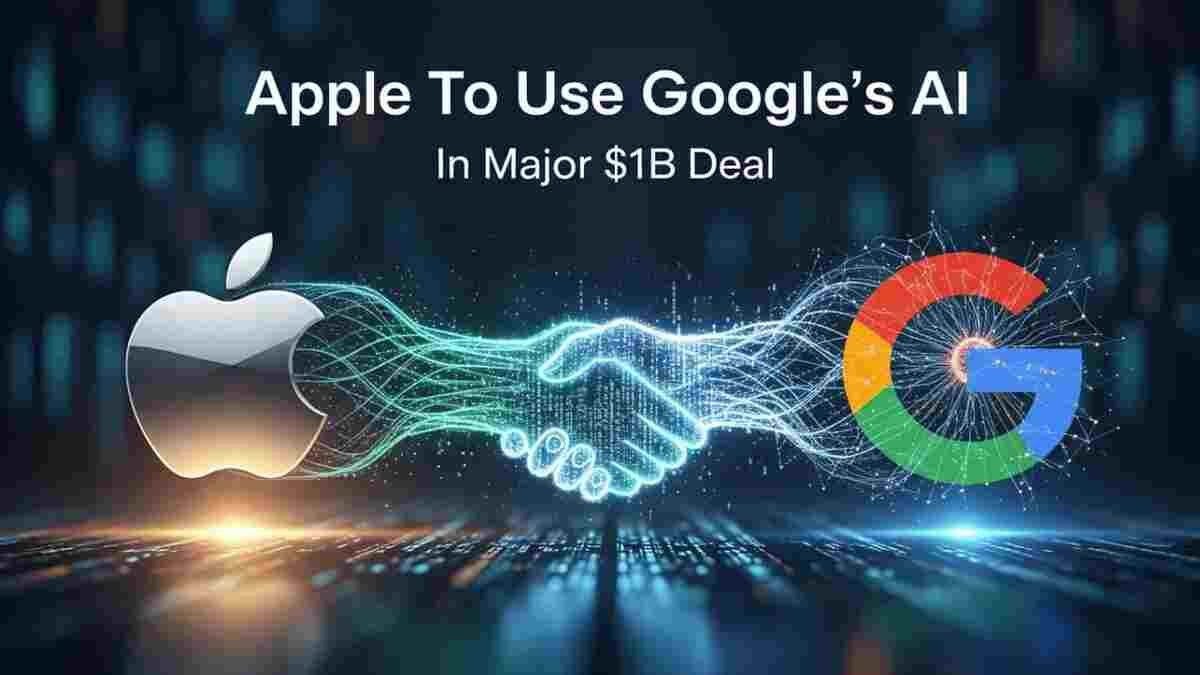
In a major shift in the global tech landscape, Apple and Google have announced a multi-year strategic partnership that will bring Google’s Gemini AI models and cloud technology into Apple’s ecosystem to power the next generation of Siri and other Apple Intelligence features. This collaboration addresses long-standing criticism of Siri’s limitations and marks a new era of AI integration for Apple devices worldwide.
At the heart of this deal is the integration of Gemini, Google’s cutting-edge suite of AI models, into Apple’s core AI infrastructure. Under the agreement, the next generation of Apple Foundation Models will be based on Google’s Gemini models and cloud services. These advanced language models are expected to dramatically enhance Siri’s performance, making it more personalized, responsive, and context-aware than ever before.
Apple has historically developed many of its technologies in-house, but this move signifies a strategic pivot in its AI strategy. The company acknowledged that relying on Google’s AI technology offers the strongest foundation for rapid improvements, especially for computationally heavy tasks that traditional on-device models struggle with. Importantly, Apple emphasized that privacy will remain a core priority, and Apple Intelligence will continue to operate on devices and through Apple’s Private Cloud Compute system, aligning with Apple’s longstanding commitment to user data protection.
What This Means for Siri Users
The revamped Siri is expected to roll out later this year, potentially with the release of iOS 26.4 or beyond, bringing a suite of AI-powered capabilities that far exceed the current assistant’s abilities. Early previews suggest users can expect:
- Improved conversational intelligence with better understanding of complex queries.
- Contextual awareness that adjusts responses based on user history and device activity.
- Faster, more natural interactions, rivaling competitors like Google Assistant and ChatGPT-powered assistants.
- Deeper integration across iPhone, iPad, and other Apple devices thanks to Gemini’s multimodal capabilities.
This marks a stark transformation from Siri’s previous iterations, which often lagged behind rivals in AI fluency and accuracy. Apple’s decision to adopt external models reflects the urgency to catch up in the AI-driven assistant race — a space dominated by powerful systems like Google Assistant and ChatGPT-powered tools.
Industry and Market Impact
The partnership has already created ripples across the tech and investor communities. Google’s parent company, Alphabet, briefly surpassed a $4 trillion valuation, in part fueled by investor optimism around the Gemini model’s expanded reach through Apple’s vast user base.
Analysts believe the collaboration could be worth several billion dollars, with some industry estimates suggesting Apple may invest around $1 billion annually for access to Google’s AI technology — though neither company has officially confirmed exact financial terms.
This arrangement also reconfigures parts of the competitive AI landscape: Apple is maintaining some ties with other AI partners like OpenAI, but Google’s deep involvement raises strategic questions about the balance of power in AI development and device ecosystems.
Challenges and Criticisms
While many welcome Siri’s long-overdue AI upgrade, not all responses have been positive. Industry figures like Elon Musk have publicly criticized the partnership, warning that the deep integration could further strengthen Google’s dominance in AI and raise antitrust and privacy concerns.
Additionally, integrating a competitor’s core technology raises questions about Apple’s traditional values of vertical integration and ecosystem control — conditions that may evolve as this partnership matures.
Looking Ahead
As Apple prepares to roll out its AI-enhanced Siri later this year, users and industry watchers alike will be watching closely to see how this collaboration reshapes expectations for voice assistants and sets the stage for future innovation in AI-powered mobile computing.
If you’d like, I can also break down how these AI advancements compare with rival assistants like Google Assistant and ChatGPT-integrated systems.