
















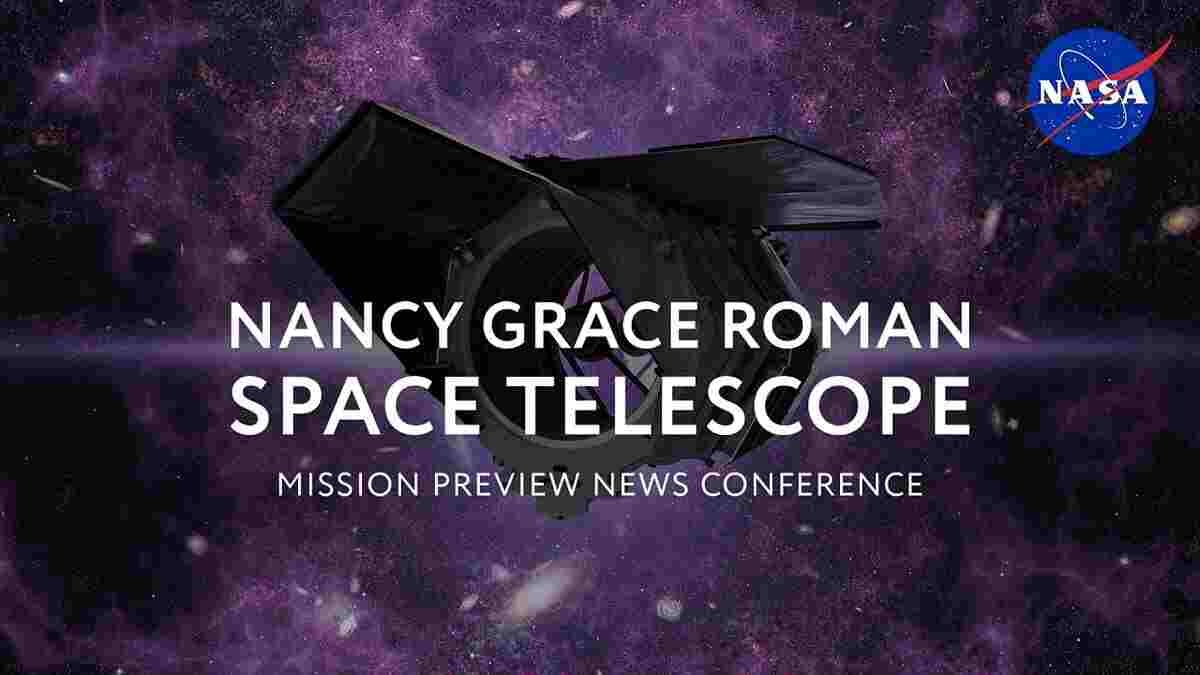
NASA’s Nancy Grace Roman Space Telescope made a major engineering breakthrough today when its optics performed 30% better than the required image quality. The breakthrough comes after a string of a precision alignments by engineers that has continued to push the observatory toward its ultimately planned scientific mission and has increased anticipation for the space telescope’s exploration of the universe.
NASA reports the Wide Field Instrument on the telescope is now providing an optical performance error of approximately 63 nanometers RMS, a lot improved from the mission requirement of 90 nanometers RMS.
The fine-tuning involved extremely minute changes. NASA engineers were able to move Roman’s secondary mirror by just one-sixteenth of a human hair. While the movement was nearly imperceptible to the naked eye, it improved the overall alignment of the telescope’s mirror and optics.
Before launch the teams carried out extensive ground tests and computer modelling to make sure that the observatory would be able to operate at the high performance levels it was designed for. But it is a different environment up in space to that of our planet.
After the launch of the telescope on August 30 2026 engineers started inspecting and calibrating the telescope’s instruments. At that point, the condition of the telescope’s instruments was pretty good and the tools needed only a slight adjustment for optimal orientation.
The device marries the Hubble’s famed acuity with a field of view at least 100 times wider. So, Roman can scan large expanses of space far faster than Hubble, enabling astronomers to gather data from billions of galaxies and thousands of planetary systems.
Having a telescope that brings a wider view of the sky is mainly beneficial for those conducting all-sky surveys, which necessitate frequent lunar and celestial observations from researchers. The telescope’s improved optics might enable scientists to acquire more precise readings and analyze finer details in objects’ shapes, brightness, and locations.
Roman’s mission extends beyond capturing spectacular astronomical images. One of its principal objectives is to investigate dark matter and dark energy, two major components of the universe that remain poorly understood.
Although dark matter doesn’t emit or reflect light like the matter we are familiar with, researchers can indirectly observe its presence by detecting how its gravity affects light travelling through space. Roman will measure how the light of faraway galaxies is bent as it travels through space to chart the distribution of matter throughout the universe.
Dark energy the observatory is also set to study the mysterious dark energy, that is thought to drive the acceleration of our universe. Through its wide area maps the observatory will enable researchers to study the cosmic structures and the distances of objects in the universe through cosmic time.
On top of hunting for planets outside of our solar system, the Roman telescope will also help investigate the formation and evolution of planetary systems. The Corongraph Instrument that is part of the Roman telescope will mask the glare from stars, which could help spot much more faint objects around stars. Per NASA, the coronagraph team will be testing the instrument and preparing to demonstrate how well it blocks light.