


















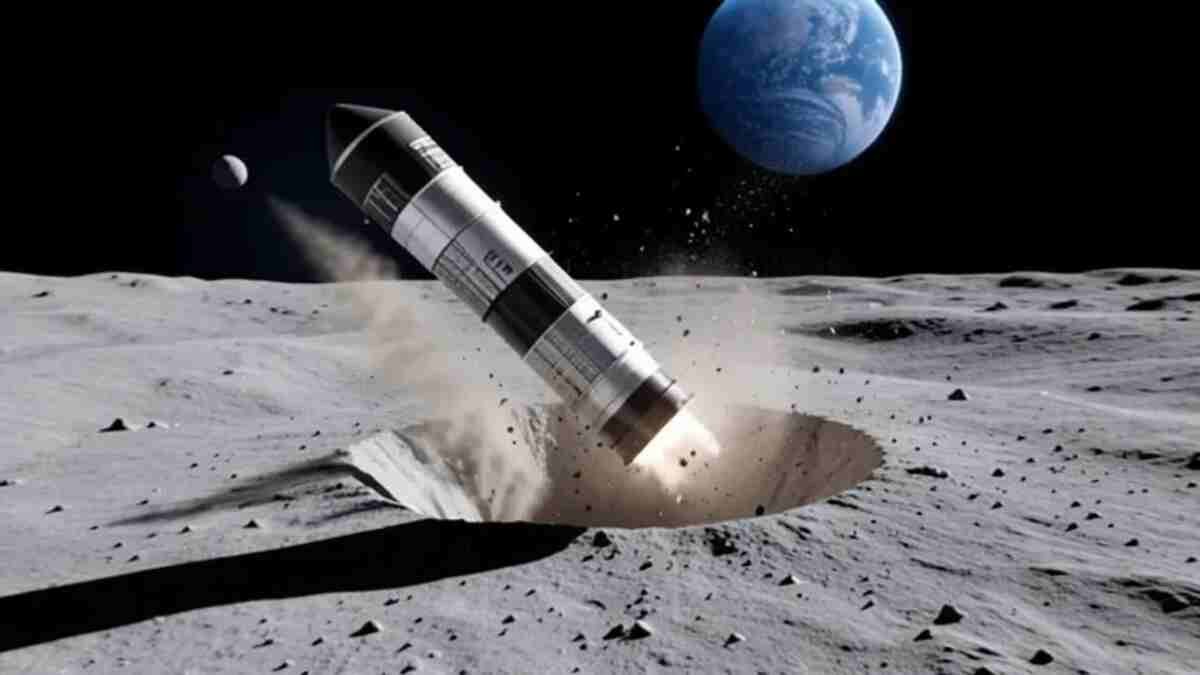
The orbit of a lost, extra-long SpaceX Falcon 9 upper stage has permanently scarred the Moon. The unneeded booster wrecker hit the lunar surface on 05 August 2026 nearEinstein crater, producing a crater of approximately 60 ft in diameter and less than 10 ft deep.
On 11 August 2026, NASA’s Lunar Reconnaissance Orbiter provided sharp images of the recent impact location, turning an anticipated event into a photographic reality. The stage was launched in January 2025 (as part of the Firefly Blue Ghost Mission 1 it successfully put a lander on the Moon) and after it had done its job, the single 8 793-pound (3,990kg) upper stage parked itself in a highly elliptical orbit that made a number of passes through the Moon’s vicinity each month.
It was in that orbit for more than a year, under the subtle but persistent effects of Earth’s, the Moon’s, and the Sun’s gravity, until ultimately, an impact was the only option. Traveling at approximately 5,400 milesper[translation]…. NASA, the Lunar Reconnaissance Orbiter which orbits it at about 60 miles altitude, took pictures of the site between 11 and 12 August.
The craft was tilted so the Narrow Angle Camera could be aimed at the location at each pass. The Narrow Angle Camera is able to recognize features as small as three feet in size so using the image, the scientists were able to determine the width of the crater by measuring the length of its rim and estimate the depth by measuring the length of the shadow of the crater. Between and around the rays, they show bright and dark ejecta rays emanating from the spike.
The dark material was old lunar dust and rock long exposed to solar winds, galactic cosmic rays, and micrometeoroids. In the upper inches of the Moon, this field layer was excavated from approximately a foot and a half below the surface. The brighter rays closer to the edge are fresher material removed from more than a foot below the surface.
Another image was taken by South Korea’s Danuri orbiter very soon after impact. It was very close to NASA’s previous estimates confirming that the south Korea. Danuri’s additional image narrowed down the impact center to within a mile of NASA’s previous estimate the exact location being, with a center of the crater at 19.4759 N and 266.7138 E at a height of 511 meters. Human-made hardware on the Moon is not a new occurrence.
From early Soviet probes to more recent intentional and accidental impacts, the Moon’s Little Brother has become a repository of evolving technological artifacts. What makes this particular impact unique is the availability of pre- and post-impact images and the chance to examine the effects of a modest, well understood object. The actual crater was slightly shallower than some of the pre-impact expectations so this was valuable data to help improve further predictions.
The observed ejecta distribution and crater shape/characteristics can be compared with models to improve our understanding of impacts on an airless body. Reflecting the larger space environment, this represents a source of the growing human presence outside Earth. With more and more spacecraft traversing the Moon, there will be an increasing number of discarded stages and other space debris to be (tracked and) disposed of in cislunar space.