














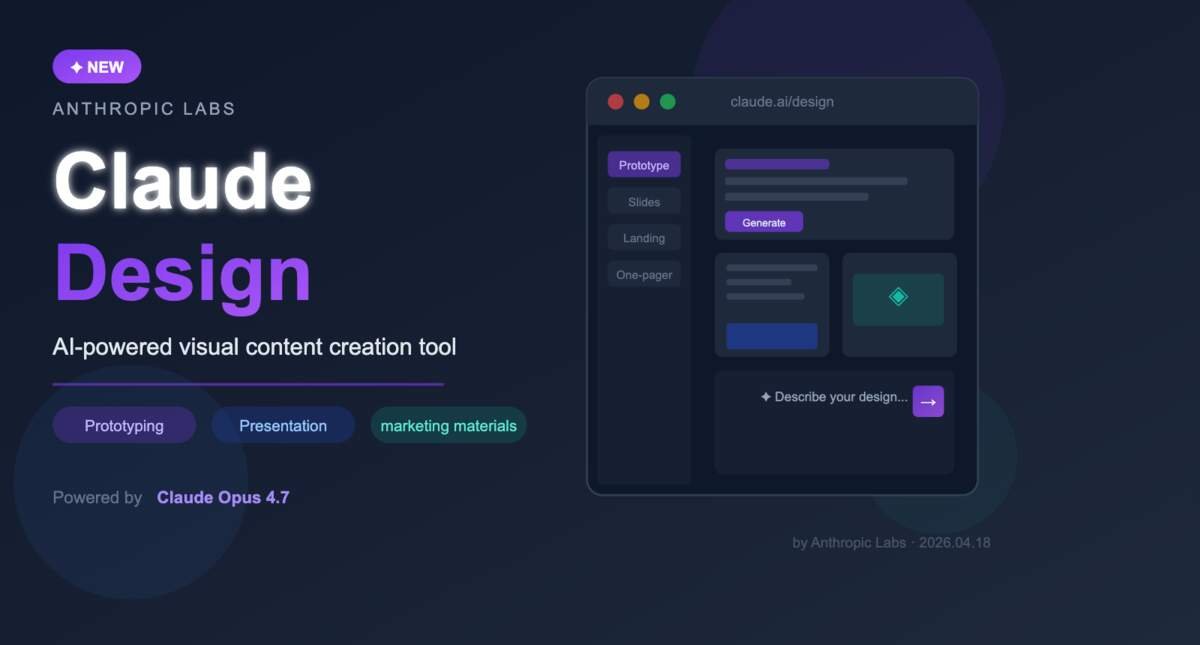
Anthropic has unveiled Claude Design, a groundbreaking new AI-powered tool that lets users create professional-quality visuals through simple conversation. Launched on April 17, 2026, by Anthropic Labs, the experimental product enables founders, product managers, marketers, and non-designers to generate prototypes, slide decks, one-pagers, interactive interfaces, and marketing collateral without needing traditional design software skills.
Powered by the newly released Claude Opus 4.7 — Anthropic’s most advanced vision model to date — Claude Design marks the company’s boldest step yet into the visual productivity space. Users start by describing their idea in plain language. Claude quickly produces an initial version, which can then be refined through natural follow-up prompts, inline comments, direct edits, or intuitive tweak sliders. The process feels remarkably fluid, turning rough concepts into polished, on-brand outputs in a fraction of the time required by conventional tools.
One of the tool’s standout features is its ability to understand and apply team-specific design systems. Users can upload codebases or existing design files, allowing Claude to analyze brand colors, typography, components, and guidelines. It then automatically maintains consistency across every asset. This capability particularly appeals to product teams and startups that want to move fast while preserving a professional appearance. Teams can maintain multiple design systems within the same workspace, making collaboration seamless even across departments.
Claude Design stands out from many existing AI image generators because it focuses on structured, editable, and exportable visual work rather than purely artistic outputs. The tool supports interactive prototypes that mimic real app flows, presentation slides ready for pitching investors, and one-pagers ideal for quick proposals or landing pages. Once satisfied with the result, users can export files as PDF, PPTX, or hand them off directly to Claude Code for further development into functional code. Integration with Canva is also available for those who prefer to continue editing in familiar environments.
The launch comes at a moment when speed to visualization has become critical in business. Founders often need to mock up an app idea during a weekend brainstorming session. Marketers require fresh campaign assets on tight deadlines. Product teams want to test multiple UI directions before committing engineering resources. Claude Design addresses these pain points by removing the traditional bottleneck of waiting for designers or learning complex software like Figma or Adobe tools.
Early feedback highlights how the conversational interface lowers the barrier dramatically. Instead of wrestling with layers and alignment tools, users simply say what they want to change — “make the button larger and move it to the center” or “add a dark mode toggle and update the color palette to ocean tones.” Claude responds instantly, often suggesting smart alternatives or improvements based on best design practices. The inclusion of fine-grained controls, such as sliders for typography scale or layout density, gives precise control without overwhelming beginners.
Industry observers note that the announcement sent ripples through the design software market. Reports indicated immediate pressure on stocks of companies like Figma and Adobe as investors weighed the potential disruption from an AI-native tool built from the ground up. Unlike plugins or copilots added to existing platforms, Claude Design operates as a standalone product, offering a clean, focused experience dedicated entirely to rapid visual creation.
Availability is currently limited to a research preview for Claude Pro, Max, Team, and Enterprise subscribers, with rollout happening gradually. Anthropic positions the tool as an experimental offering, inviting user feedback to shape future improvements. The company emphasizes responsible development, ensuring outputs remain editable and human-guided rather than fully autonomous.
For many professionals, Claude Design represents more than convenience — it signals a shift in how creative and technical work intersect. Ideas that once required days of back-and-forth with design teams can now reach a shareable stage in minutes. This acceleration could empower smaller teams and solo entrepreneurs to compete more effectively with larger organizations that have dedicated design resources.
As AI continues to evolve, tools like Claude Design are redefining productivity boundaries. They free human talent to focus on strategy, creativity, and decision-making while handling the repetitive aspects of visual execution. Anthropic’s move into dedicated application layers beyond core language modeling suggests more specialized AI products may follow, further expanding Claude’s utility across workflows.
Users eager to try the new capability can access it at claude.ai/design once their plan eligibility rolls out. With its emphasis on speed, consistency, and collaboration, Claude Design is poised to become an essential part of modern idea-to-visual pipelines. Whether building the next big app prototype or preparing a compelling investor deck, the tool promises to make professional visuals accessible to anyone with a clear idea and the ability to describe it.